Covariates
TiRex-2 natively conditions its forecast on two kinds of covariates, in addition to the target history. Both are optional and independent of each other and of whether the target itself is univariate or multivariate.
Past covariates
past_covariates are known only up to the current time — like the target itself, they stop
at the end of the context window. Shape: (num_past_covariates, context_length), matching
the target's context_length exactly.
import torch
from tirex2 import TimeseriesType, load_model

context_length = 512
prediction_length=42
target = torch.randn(1, context_length)

past_covariates = torch.randn(2, context_length)  # 2 past-only covariates

ts = TimeseriesType(target=target, past_covariates=past_covariates, future_covariates=None)

model = load_model("NX-AI/TiRex-2", device="cpu")
forecast = model.forecast([ts], prediction_length=prediction_length, output_type="numpy")[0]
Future-known covariates
future_covariates are known ahead of time for the whole forecast horizon — calendar
features, holidays, promotions, or scheduled interventions are typical examples. Shape:
(num_future_covariates, context_length + prediction_length); if you pass more steps than
context_length + prediction_length, the extra trailing steps are ignored.
import torch
from tirex2 import TimeseriesType, load_model

context_length = 512
prediction_length=42
target = torch.randn(1, context_length)

future_covariates = torch.zeros(1, context_length + prediction_length)
future_covariates[0, 100::7] = 1.0  # e.g. a weekly recurring event flag

ts = TimeseriesType(target=target, past_covariates=None, future_covariates=future_covariates)

model = load_model("NX-AI/TiRex-2", device="cpu")
forecast = model.forecast([ts], prediction_length=42, output_type="numpy")[0]
Combining both
Past and future covariates can be combined freely on the same series:
ts = TimeseriesType(
    target=target,
    past_covariates=past_covariates,
    future_covariates=future_covariates,
)
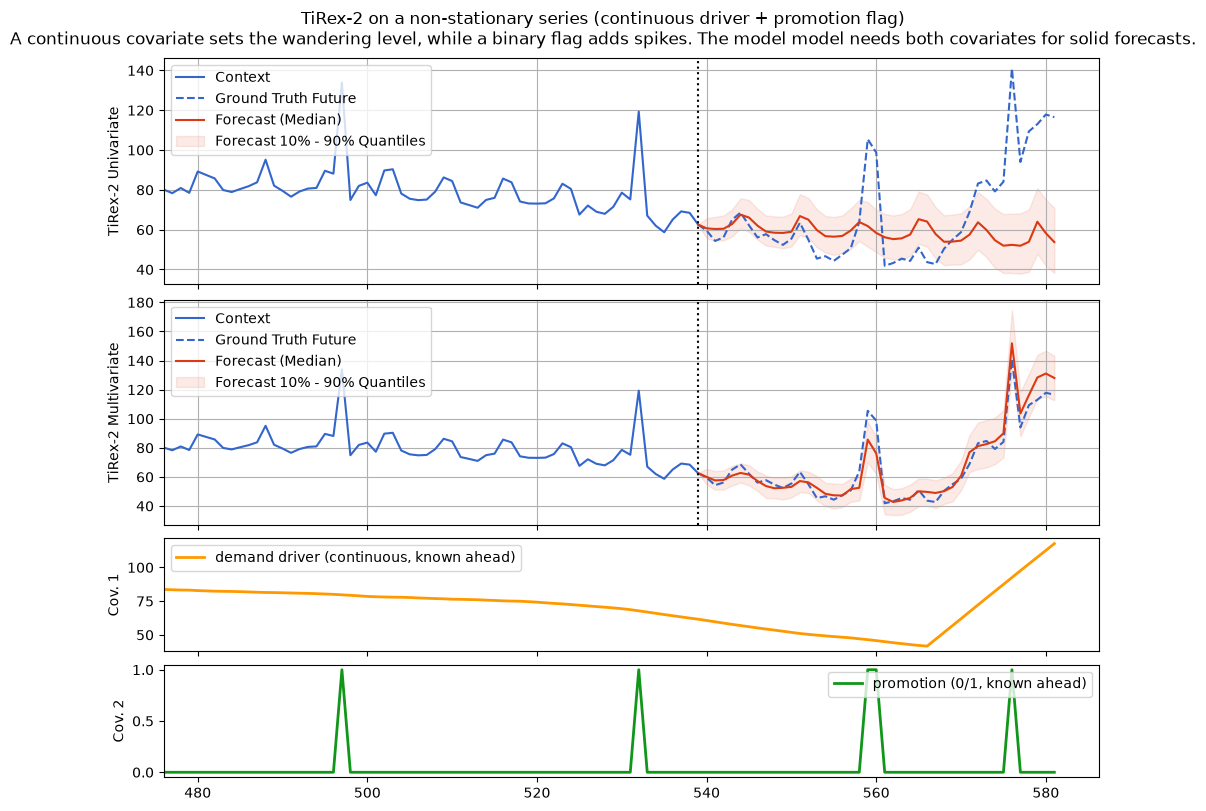
Worked example: a non-stationary series with two covariates
The Demo class used in the Quickstart
builds exactly this kind of input — a continuous future-known driver that sets a wandering
baseline level, plus a binary future-known promotion flag that adds spikes:
import torch
from tirex2 import TimeseriesType, load_model
from tirex2.demo import Demo
import numpy as np

demo_nonstationary = Demo.create_nonstationary_demo()
# univariate target shape: (1, context_length)
target = torch.from_numpy(demo_nonstationary.target_context).unsqueeze(0)

# future-known covariates shape: (n_covariates, context_length + horizon)
future_covariates = torch.from_numpy(
    np.stack([np.concatenate([c.context, c.future]) for c in demo_nonstationary.covariates]).astype(np.float32)
)

# multivariate forecast conditioning: the target plus future-known covariates.
multivariate_nonstationary = TimeseriesType(
    target=target,
    past_covariates=None,
    future_covariates=future_covariates,
)

model = load_model("NX-AI/TiRex-2", device="cpu")

forecast = model.forecast(
    timeseries=[multivariate_nonstationary],
    prediction_length=42,
    output_type="numpy",
)[0]

# forecast.shape == (1, 9, 42)  -> (num_target_variates, num_quantiles, prediction_length)