Forecasting
The TimeseriesType input
Every forecast call takes a list of TimeseriesType
objects — one per series in the batch. Each holds:
target: tensor of shape(num_target_variates, context_length).past_covariates:None, or a tensor of shape(num_past_covariates, context_length).future_covariates:None, or a tensor of shape(n_future_covariates, context_length + prediction_length)(extra trailing steps beyond what's needed are ignored). See Covariates for a full walkthrough.
A single-variate target (a plain 1D series) is still passed as a 2D tensor with
num_target_variates == 1 — the same model and API path serve both univariate and
multivariate forecasting.
Loading the model
from tirex2 import load_model

model = load_model("NX-AI/TiRex-2", device="cpu")  # or device="cuda"
load_model returns a ForecastModel wrapping
the backbone; unknown attributes fall through to the underlying model, so
model.quantiles and similar backbone attributes remain reachable directly.
use_flex_attention overrides every variate mixer's checkpoint setting. True enables block-sparse FlexAttention, which can reduce the cost of large grouped multivariate batches on CUDA but adds first-call compilation overhead. False forces dense attention. Leave it unset to keep the checkpoint configuration.
model = load_model("NX-AI/TiRex-2", device="cuda", use_flex_attention=True)
compile applies torch.compile to the mLSTM on every device, and sLSTM
on CPU/MPS only. Compilation happens on the first forecast per input shape, so it pays off for repeated calls rather than one-shot use. It applies per model instance.
model = load_model("NX-AI/TiRex-2", device="cpu", compile=True)
See #47 for the change and its CPU/CUDA benchmarks.
Univariate forecasting
import torch
from tirex2 import TimeseriesType, load_model

# (num_target_variates=1, context_length)
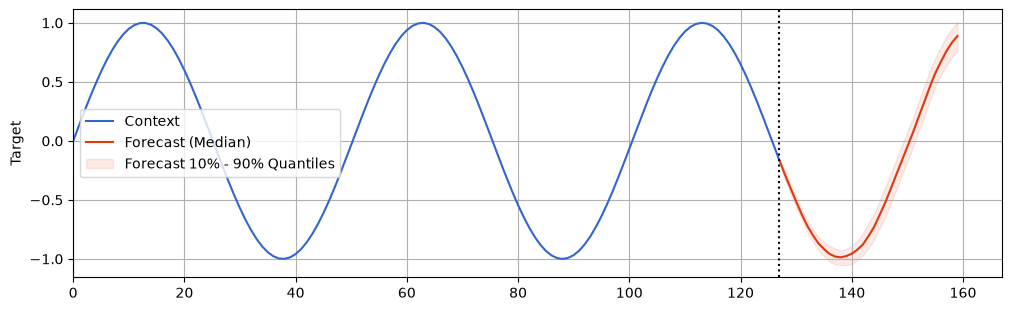
context = torch.sin(torch.arange(128).float() / 8)
ts_univariate = TimeseriesType(target=context, past_covariates=None, future_covariates=None)

model = load_model("NX-AI/TiRex-2", device="cpu")

forecast = model.forecast([ts_univariate], prediction_length=64, output_type="numpy")[0]
# forecast.shape == (1, 9, 64)  -> (num_target_variates, num_quantiles, prediction_length)
Multivariate forecasting
The primary goal of multitarget forecasting is to model complex systems where multiple signals interact jointly, allowing the model to capture both the temporal structure within each individual time series and the cross-variate dependencies among them.
Pass a target with more than one row to forecast several variates jointly from a single checkpoint — no separate model or per-variate training is needed:
import torch
from tirex2 import TimeseriesType, load_model
from tirex2.demo import Demo

demo_nonstationary = Demo.create_nonstationary_demo()
demo_holidays = Demo.create_holidays_demo()

# Stack variates together
multi_target = torch.stack(
    [
        torch.from_numpy(demo_holidays.target_context),
        torch.from_numpy(demo_nonstationary.target_context),
    ]
)

multi_target_ts = TimeseriesType(
    target=multi_target,
    past_covariates=None,
    future_covariates=None,
)

model = load_model("NX-AI/TiRex-2", device="cpu")

multi_target_forecast = model.forecast(
    [multi_target_ts],
    prediction_length=42,
    output_type="numpy",
    batch_size=1,
)[0]

# forecast.shape == (2, 9, 42)  -> (num_target_variates, num_quantiles, prediction_length)
See Covariates for past vs. future-known covariates.
Batching multiple series
forecast accepts a list of TimeseriesType — each entry can have a different number of
variates and a different context length, and covariates are optional per series:
import torch
from tirex2 import TimeseriesType, load_model

context_length_a = 128
ts_a = torch.randn(1, context_length_a)
ts_a = TimeseriesType(
    target=ts_a,
    past_covariates=None,
    future_covariates=None,
)

context_length_b = 128
ts_b = torch.randn(1, context_length_b)
ts_b = TimeseriesType(
    target=ts_b,
    past_covariates=None,
    future_covariates=None,
)

context_length_c = 128
ts_c = torch.randn(1, context_length_c)
ts_c = TimeseriesType(
    target=ts_c,
    past_covariates=None,
    future_covariates=None,
)

model = load_model("NX-AI/TiRex-2", device="cpu")
forecasts = model.forecast([ts_a, ts_b, ts_c], prediction_length=64, output_type="numpy")
# forecasts is a list, one entry per input series
Internally, series are grouped into batches of at most batch_size (default 512); on a
CUDA out-of-memory error the batch size is automatically halved and the failing batch
retried, without affecting the rest of the call.
Output types
output_type controls the returned format:
output_type |
Returns | Requires |
|---|---|---|
"torch" (default) |
list of torch.Tensor, shape (V, 9, H) |
— |
"numpy" |
list of numpy.ndarray, shape (V, 9, H) |
— |
"gluonts" |
list of GluonTS QuantileForecast |
pip install "tirex-2[gluonts]" |
"fev" |
a datasets.DatasetDict for fev.Task.evaluation_summary |
pip install "tirex-2[fev]" |
"dataframe" |
one long-format frame, in the input's dataframe library | a dataframe library |
"pandas" |
the same frame, always as pandas | pip install pandas |
Tip: using dataframes with TiRex-2
If you use pandas, Polars, or cuDF, you can pass a dataframe to
forecast_df and get a long-format
dataframe with the forecast quantiles. See the dataframe guide for a full
walkthrough.
The 9 quantiles are the levels 0.1, 0.2, ..., 0.9, with index 4 being the median.
Test-time augmentation options
Extra keyword arguments passed to forecast(...) are forwarded to the backbone's
predict:
tta_sign_flip: bool— opt-in sign-flip test-time augmentation: the model is also run on the sign-flipped input and the two passes are averaged in level space. Roughly doubles inference cost. Defaults to the checkpoint's configured setting when omitted.tta_diff: bool— opt-in differencing inside the postprocessor. Defaults to the checkpoint's configured setting when omitted.
forecast = model.forecast([ts], prediction_length=64, tta_sign_flip=True)
Context padding
By default (pad_context=True in forecast(...)), contexts shorter than the model's default
context length (2,048) are left-padded with NaN, as in training. Setting pad_context=False
skips padding to the model's full context length, reducing the number of input patches and
speeding up inference for short contexts at the cost of a small loss in forecast accuracy.
Shorter series are still left-padded with NaN to the longest context in their batch, and
the tokenizer adds any left-padding needed to form whole patches.
forecast = model.forecast([ts], prediction_length=64, pad_context=False)
See #57 for speed and accuracy benchmarks.
GluonTS and FEV integration
For GluonTS datasets, use
forecast_gluon instead of
building TimeseriesType objects by hand; it extracts targets, covariates, and item metadata
from each dataset entry directly. For FEV evaluation windows, use
forecast_fev. See
Benchmarks for the full GIFT-Eval and fev-bench reproduction paths that
build on these.